
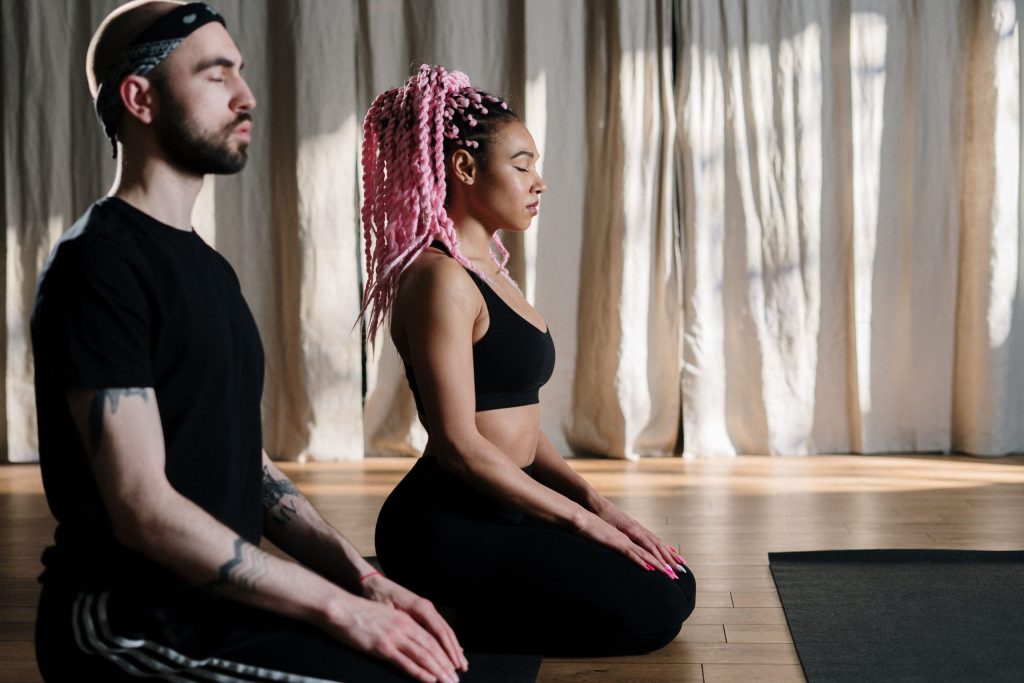
What is Yin Yoga?
In simple words, it is a new style where certain passive yoga poses are held for a longer duration of time. The poses can be held for 3-10 minutes. Contrary to the belief that Yin Yoga is from China, this concept is taken from the ancient practice of Classical Hatha Yoga – where the poses were held from 3-to 10 minutes. It is important to know that originally Hatha Yoga was practised by monks who were practising yoga as an austere practice. But when teachers like Swami Sivananda introduced Hatha Yoga to common people, they modified the duration to 1-3 minutes to make it accessible for everyone.
In Yin Yoga, only the passive (yin) poses are used. The use of muscles is kept to a minimum, so the muscles are gently engaged to hold the posture without any extra effort. As the poses are to be held for a longer duration, the use of props like cushions, bolsters, etc., is encouraged. The poses are also taken from Hatha Yoga but new names are given to avoid direct association.
History of Yin Yoga
Some people believe that this is a centuries-old yoga style. This is not true, and it is based on the association of the word ‘yin’ with ancient Chinese medicine.
Yin Yoga started in the late 1980s when Paul Grilley saw a presentation on national television by Paulie Zink, a martial arts champion and Taoist Yoga teacher. Paul Grilley got impressed by the flexibility and range of motion of Paulie Zink. So, he went to Paulie Zink and attended his Taoist Yoga classes. There, Paul practised holding the poses for long durations of five to ten minutes. Even after doing Taoist Yoga classes regularly for many months, Paul saw not much improvement in his flexibility. So, he stopped going to the classes and continued to practice and teach the dynamic forms of yoga, like Vinyasa Yoga.
With time, he started to teach some passive stretching classes to his students. The results were overwhelming; he saw quick improvement in the range of motion of his students. As he had an inclination to Buddhism and he did not want people to confuse his classes with Indian Hatha Yoga, he called his classes Yin Yang Yoga.
A student of Grilley, Sarah Powers, pointed out that as he is only teaching passive yin poses, he should better call it Yin Yoga. From this moment onward, ‘Yin Yoga’ started to spread throughout the yoga community.
Difference Between Yin Yoga & Other Yoga Styles
Duration of an asana
The primary difference is the duration of holding a pose. In Yin Yoga, we hold most poses between 5 and 10 minutes. This is in contrast to the dynamic forms like Ashtanga Vinyasa and Vinyasa Flow, where the poses are held for 5 to 10 breaths, and we constantly move in and out of the poses.
Even though Hatha Yoga is much more static, most poses (for beginners) are held up to a maximum of 3 minutes. So, in Hatha Yoga, too, we usually do not hold the poses as long as in Yin Yoga.
When we hold a pose for a longer period, we bring the stretch to the yin tissues, which are the deeper tissues such as the tendons, fascia, ligaments, and the other connective body tissues. Our yin tissues are less vascular (supplied with blood) and less elastic, and therefore need more time to stretch. When stretched regularly, it increases the overall flexibility, circulation, and range of motion in the joints and ligaments.
In dynamic styles, such as Vinyasa Yoga, and modern Hatha Yoga, the movement makes the muscles take the main load and stretch. Muscles are yang tissues; they are quick to warm up and stretch but also quick to cool down and rebound. That is why, if you do not practice for a few days, you see a big decline in flexibility and strength.
So, if you practice only dynamic forms of exercise or yoga, you will gain muscle strength, but not necessarily a wider range of motion. To have a healthy range of motion around our joints, many of us need to also stretch the deep connective tissue and the joints.
Breathing Pattern
Conscious, controlled breathing is a central aspect of yoga. The way we regulate our breathing affects how our muscles and minds respond to a particular pose. In Yin Yoga, the emphasis is on relaxed belly breathing. Long, slow, and, deep breaths are vital for letting the body relax and be in a pose for longer durations.
Concept of Yin and Yang in Yoga
The concept of yin and yang is similar to the concepts of Ida (moon) and Pingala (sun) from the Hatha Yoga tradition. Yin Yang is mentioned in Traditional Chinese Medicine, and Ida Pingala is mentioned in yoga and Ayurveda.
These are ancient principles that describe the two opposite forces in nature that are present in everything. The principle of yin and yang, while contrary to each other, is not rigid but more relative.
Yin refers to slow, soft, passive, and cold. It is also associated with water, earth, moon, femininity, heavy, and night. Yang, on the other hand, refers to fast, hard, active, hot, masculine, light, and day.
In yoga, we see this difference in the practice of asanas. Some poses are passive and activate yin qualities in the body and mind, whereas other poses are more dynamic and active, activating yang qualities.
Yin & Yang Tissues
Bones, tendons, ligaments, and discs are yin tissues. Muscle and blood are yang tissues.
Yin tissues resist stretching, and they rebound slowly like stiff dough. Muscles stretch easily and rebound quickly like rubber. All tissues are a blend of yin and yang qualities. For example, the tendon of a muscle can be dense like a ligament (yin), but the belly of that muscle can be quite soft and elastic (yang).
Yin & Yang Yoga
According to Paul Grilley, all tissues can be worked out in a yin way or a yang way. What is unsafe in a yang practice might be safe in a yin practice and the other way around.
If you train fascia in a yin way, it becomes longer and more elastic. If you train fascia in a yang way, it becomes shorter, stronger, and stiffer. Yin Yoga is slow and static-like traction. Yang Yoga is rhythmic, and repetitive like weightlifting or running. In Yin Yoga, the targeted muscles are relaxed. In Yang Yoga, targeted muscles are generally contracted.
Functional Principles of Yin Yoga
When practising and teaching Yin Yoga, you should keep these principles in mind:
The purpose of yoga is to harmonize the flow of the prana (life energy) in our bodies. This is accomplished by stressing the deep connective tissues.
In a functional approach to Yin Yoga there is no perfect pose. Every hand and foot position either helps or inhibits our ability to stress the target areas. The most effective way to do this varies from person to person.
Every bone in everybody is different. What is easy for one skeleton may be impossible for another.
The three stresses used in the yin poses are tension, contraction & compression.
Flexibility refers to the extensibility (capacity to stretch) of the myofascial groups, ligaments, joint capsules, and discs. Compression is the ultimate range of motion in every person.
What are the Benefits of Yin Yoga
Physical Benefits
The most important benefits can be summarised by understanding the effect on the following issues:
Fascia – With the long holds, we stretch and stimulate the layers of fascia in our body. With regular stress, our fascia becomes subtle, and the flow of nutrients increases. This results in the improved overall functioning of the body.
Ligaments – Our ligaments connect bones to bones. Ligaments are stiff and strong fascial bands that protect our joints from going out of place, and therefore, limit our range of motion. But ligaments are always contracting with age. With Yin Yoga, we gently stretch our ligaments and maintain the range of motion of our joints. In other words, we stay younger by stretching our ligaments.
Tendons – Our tendons are the connective tissue that connects muscle to the bone. With yang exercises, the tendons become strong and short. This results in a decreased range of motion of the tendons. This is the top reason for injury in athletes. With yin poses, we pressure and lengthen the tendons gently and retain their range of motion.
Joints – All physical movement happens at our joints. But due to the modern lifestyle which promotes a lack of movement and short-range movements, the fluids in the joint capsules decrease. This decreases the lifespan of the joint. With Yin Yoga, we put gentle pressure on the joints, which revitalizes the joints and renews the fluids.
Viscera – With gentle and long pressure on our internal organs, we stimulate them and improve their functioning.
Myofascia – As the quality of the connective tissue is improved, the range of flexibility in our muscles (myofascial) is also positively affected.
Physiological Benefits
Studies based on five-week Yin Yoga-based interventions have found that Yin Yoga works as a preventive tool in lowering plasma adrenomedullin. High ADM is one of the main causes of stress, anxiety, and depression. These are added risk factors for many non-communicable diseases. (1)
Mental Benefits
Stress release – It helps to release stress which is stored in our deeper tissues. That is why you will often see people getting emotional or silently crying during classes. You should know that such reactions are completely normal and can be expected.
Emotional balance – It stimulates our endocrine glands by pressuring them during the long-held poses. The effect is an improved hormonal balance, which results in more balanced emotions.
Clarity – There is power in stillness. The regular practice of sitting still and focusing brings mental clarity.
